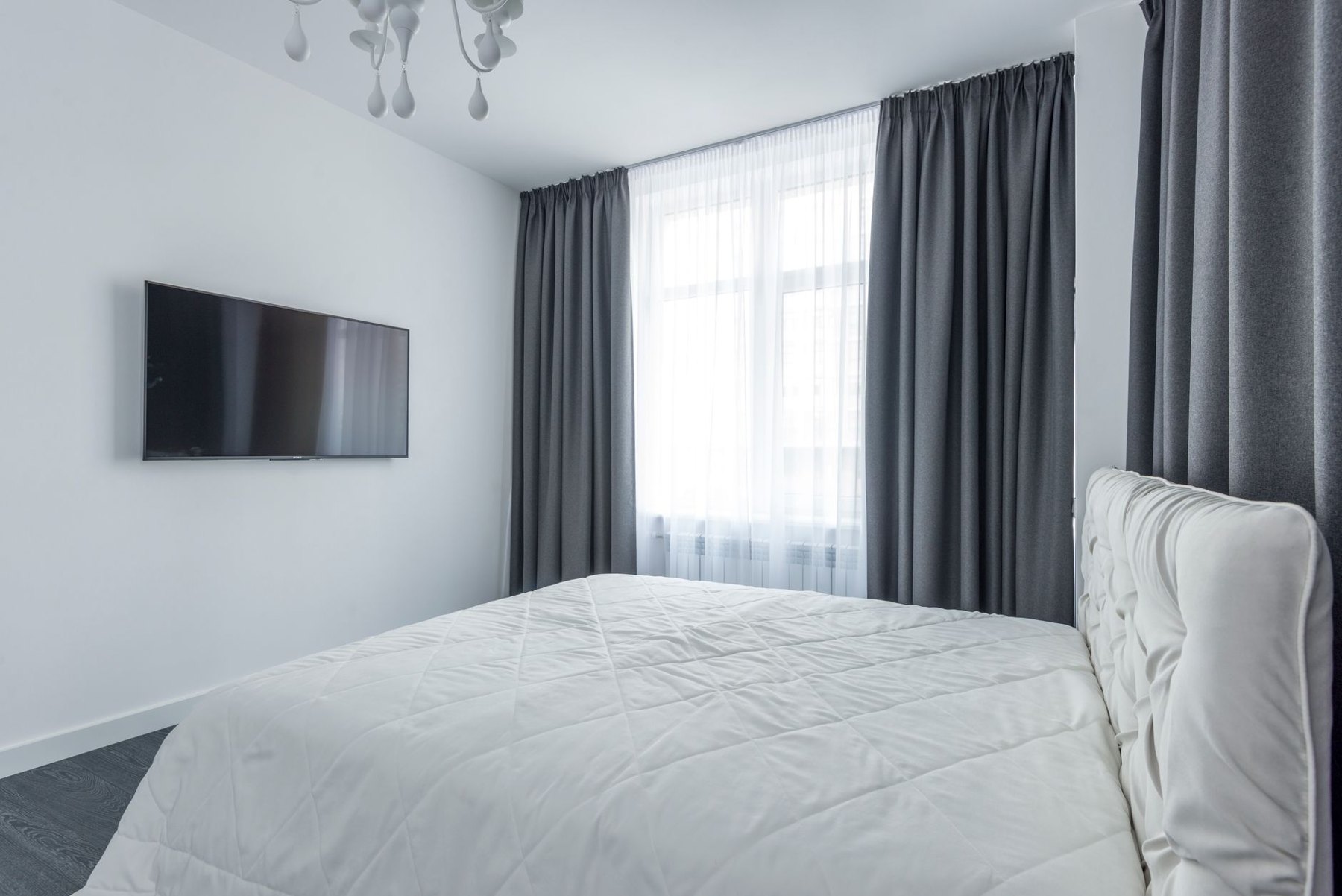
A blackout curtain can cover the whole window and still leave your bedroom bright around the edges. Without drilling, the challenge is finding a mounting method that holds the fabric securely while placing it close enough to the window to control those gaps.
Start with the window frame, the curtain’s total weight, and how often you need to open it. A tension rod suits a window recess with firm, parallel sides. Adhesive brackets can position curtains beyond the glass, provided the surface and load meet their instructions. Removable blackout panels are useful when darkness matters more than the look and movement of conventional curtains.
Which drill-free option fits your bedroom?
| Option | Best suited to | Main fit requirement | Main compromise |
|---|---|---|---|
| Tension rod and blackout curtains | Recessed windows and daily opening | Firm opposing surfaces within the rod’s stated span | Light can escape around the curtain edges |
| Adhesive curtain brackets | Windows needing wider curtain coverage | Compatible surface and sufficient rated capacity | Paint damage remains possible during removal |
| Removable blackout panels | Sleep-focused rooms and occasional use | Accurate dimensions and compatible attachment points | Opening the window takes more handling |
These are buying categories rather than interchangeable products. Check the specifications of the complete setup: a suitable curtain does not make an unsuitable mounting system safe.
Measure before choosing the curtains
Record the glass dimensions, the outer frame dimensions, and the depth of any recess. Check for handles, locks, blinds, and vents that could interfere with the fabric or mounting hardware.
- Measure the mounting position. For a tension rod, measure between the exact surfaces it will press against. For adhesive brackets, measure the available flat attachment area.
- Plan the coverage. Decide whether the fabric will sit inside the recess or extend beyond it. Outside coverage gives you more room to overlap the window edges.
- Check the drop. Measure from the actual hanging point, accounting for rings, tabs, or a rod pocket.
- Find the supported weight. Include all panels, the rod where applicable, rings, and accessories when comparing the load with the mounting instructions.
For example, a window with a deep recess may accept a tension rod but leave little room between the curtain and a projecting handle. A shallow recess may offer no useful tension-rod position at all. Discovering this before ordering is more helpful than choosing fabric by its blackout label alone.
Best for everyday use: tension-rod blackout curtains
A tension rod is a practical starting point when you have solid, parallel surfaces inside the window recess. It avoids adhesive and lets you open and close curtains in a familiar way.
Choose the rod and curtains together. Heavy lined fabric may exceed a rod’s stated capacity, particularly when extended across a wider opening. Check whether its load rating changes with span and follow any surface restrictions. Do not assume a rod suitable for a small café curtain will support full-length blackout panels.
What to look for
- A rod whose adjustment range includes your measured opening.
- A stated load capacity that covers the complete hanging load.
- End pads compatible with the surfaces they contact.
- Curtain headings that fit the rod and move without excessive pulling.
- Fabric dimensions that provide coverage without creating unnecessary weight.
The main tradeoff is edge light. A rod inside the recess keeps the curtain within the opening, so side gaps and a bright strip above the fabric may remain. A rod pocket can reduce the open space associated with some headings, but it can also make daily sliding less convenient.
Install according to the rod’s instructions and check for movement before leaving the curtains hanging. Excessive tightening can mark or damage the contact surfaces; a drill-free fitting still needs care.
Best for wider coverage: adhesive curtain mounts
Adhesive brackets are worth considering when you want the curtain to extend past the window frame. That extra coverage can help intercept light escaping around the sides and top.
The limiting factor is the attachment surface. Painted drywall, painted trim, tile, and bare wood are different substrates. A mount approved for one is not automatically suitable for another. Textured, dusty, flaking, or otherwise unsuitable surfaces should not be treated as reliable attachment points.
Read the instructions for the exact bracket system before buying the rod or curtains. Check its approved surfaces, required attachment area, load rating, rod compatibility, preparation method, and waiting time before loading. Do not add individual adhesive-strip ratings together unless the manufacturer explicitly permits that calculation for the installation.
What to check on painted surfaces
- Paint condition: avoid areas with peeling, cracking, bubbling, or loose material.
- Paint compatibility: confirm whether the adhesive permits your paint finish and requires a waiting period after painting.
- Cleaning method: use the preparation specified for the mount, while checking that it is suitable for the finish.
- Removal access: leave any release tab accessible and allow room to pull it in the instructed direction.
- Rental restrictions: check your agreement before attaching hardware to walls or trim.
Removable adhesive does not guarantee damage-free removal. Its bond depends partly on the condition of the finish underneath it. If preserving the paint is your highest priority, consider a compatible tension installation before committing to adhesive.
Best for prioritizing darkness: removable blackout panels
A removable panel covers the window more directly than a hanging curtain. Depending on the design, it may attach with suction cups, removable adhesive fittings, or hook-and-loop fasteners.
This is a useful category for someone who wants to darken a bedroom at bedtime and remove the covering in the morning. It can also suit a window where a conventional curtain would obstruct furniture. The compromise is daily handling: you need somewhere to store the panel and a convenient way to reach its attachment points.
Check whether the panel can overlap the intended opening and how its edges stay in place. An opaque sheet held only at a few points can still leave bright gaps between them. Suction attachments require a surface the manufacturer approves; adhesive fasteners require the same finish checks as other adhesive mounts.
Before placing a blackout material directly against glass, check the panel instructions and any relevant window or glazing guidance. Do not assume every material is suitable for every glazing arrangement. Keep required vents, handles, and escape-window access usable.
Control edge gaps before adding heavier fabric
Blackout fabric addresses light passing through the material. It does not automatically block light passing around it. If the panel itself looks dark but the room remains bright, inspect the perimeter before replacing it with something heavier.
- Top: look for a gap between the mounting point and the upper edge of the fabric.
- Sides: check whether the covering extends beyond the illuminated opening.
- Center: make sure paired curtains meet without separating.
- Bottom: check that the chosen length covers the opening without interfering with nearby fixtures.
For an early-morning sleeper, a modest side gap may matter more than decorative fullness. Wider coverage or a closer-fitting removable panel may address that problem more directly than a heavier curtain. Avoid solving gaps by adding unapproved attachments that increase the load or make removal difficult.
Check daily usability before you buy
Picture the morning routine. Can you draw the curtains without tugging the mounts? Can you reach the window handle? Will a removable panel be easy to detach and store? A setup that is awkward twice a day is unlikely to remain convenient.
Also check care instructions, curtain weight, and whether the fabric’s blackout description applies to the whole panel or a separate lining. Keep coverings clear of heaters and follow the appliance’s clearance requirements. Do not cover ventilation openings simply to eliminate a strip of light.
Choose a tension rod when your recess supports it and easy daily opening matters. Choose adhesive mounts when wider curtain coverage is useful and the surface is explicitly compatible. Choose removable panels when close coverage is the priority and you can accommodate the extra handling. The best fit is the one that controls your window’s actual light gaps within the mounting system’s limits.