A console table can fit against an entryway wall and still make coming home awkward. The front edge catches a shopping bag, a drawer opens into the walking route, or the legs occupy the space where shoes naturally land. The best narrow console table for a small entryway is one that works while you move past it with your hands full.
Start with the space you need to use, then decide how much furniture belongs beside it. A shallow tabletop, sensible leg placement, and one useful storage feature can do more than a larger table crowded with compartments.
Measure the walking route before choosing a table
Measure the entryway at its tightest point, including baseboards, door trim, radiators, and anything on the opposite wall. Then measure the available wall length and note nearby switches, outlets, and doors. A table that fits between two pieces of trim may still cover an outlet you need.
Use painter’s tape, where suitable for your floor finish, to mark the proposed tabletop footprint. Cardboard can help you picture its height and projecting corners. Walk through with your usual coat and bag, and carry something bulky, such as a laundry basket.
- Check the closed footprint. Walk past the marked outline in both directions without turning sideways.
- Open every nearby door. Include the front door, coat closet, and any adjacent room doors.
- Test the storage footprint. Mark how far drawers, cabinet doors, or baskets would extend when open.
- Repeat with everyday obstacles. Put shoes and bags where they usually end up and see whether the route still works.
For example, in an entryway measuring 42 inches across, a 10-inch-deep table leaves 32 inches before accounting for anything opposite it. That calculation is a starting point, not proof of a comfortable or accessible route. Your layout, household needs, and applicable clearance requirements still matter.
Choose depth before width
Depth determines how far a console reaches into the passage. Width determines how much wall it occupies. In a narrow entryway, a longer, shallower table may be easier to live with than a short, deep one, provided it clears doors and other features.
Read the overall dimensions rather than relying on the word “slim.” Check whether the stated depth includes handles, a projecting top, or angled legs. The part that sticks out farthest determines the real footprint.
Match the surface to what you actually carry
Lay out your intended essentials on a counter: a key tray, incoming mail, perhaps a small lamp. Measure that arrangement. If everything needs to sit in a single row, choose a table long enough to support it without increasing depth unnecessarily.
A very shallow surface requires restraint. A large decorative bowl can consume most of it, leaving mail balanced along the edge. Choose accessories after the table dimensions are settled, and leave a clear landing spot for whatever is in your hand when you arrive.
Compare console styles by the problem they solve
Without verified product specifications, the most useful shortlist is by design. These styles suit different routines; none is automatically the best choice for every small entrance.
| Console style | Best suited to | Main tradeoff |
|---|---|---|
| Shallow open console | A key tray and a small amount of daily mail | Offers little concealed storage |
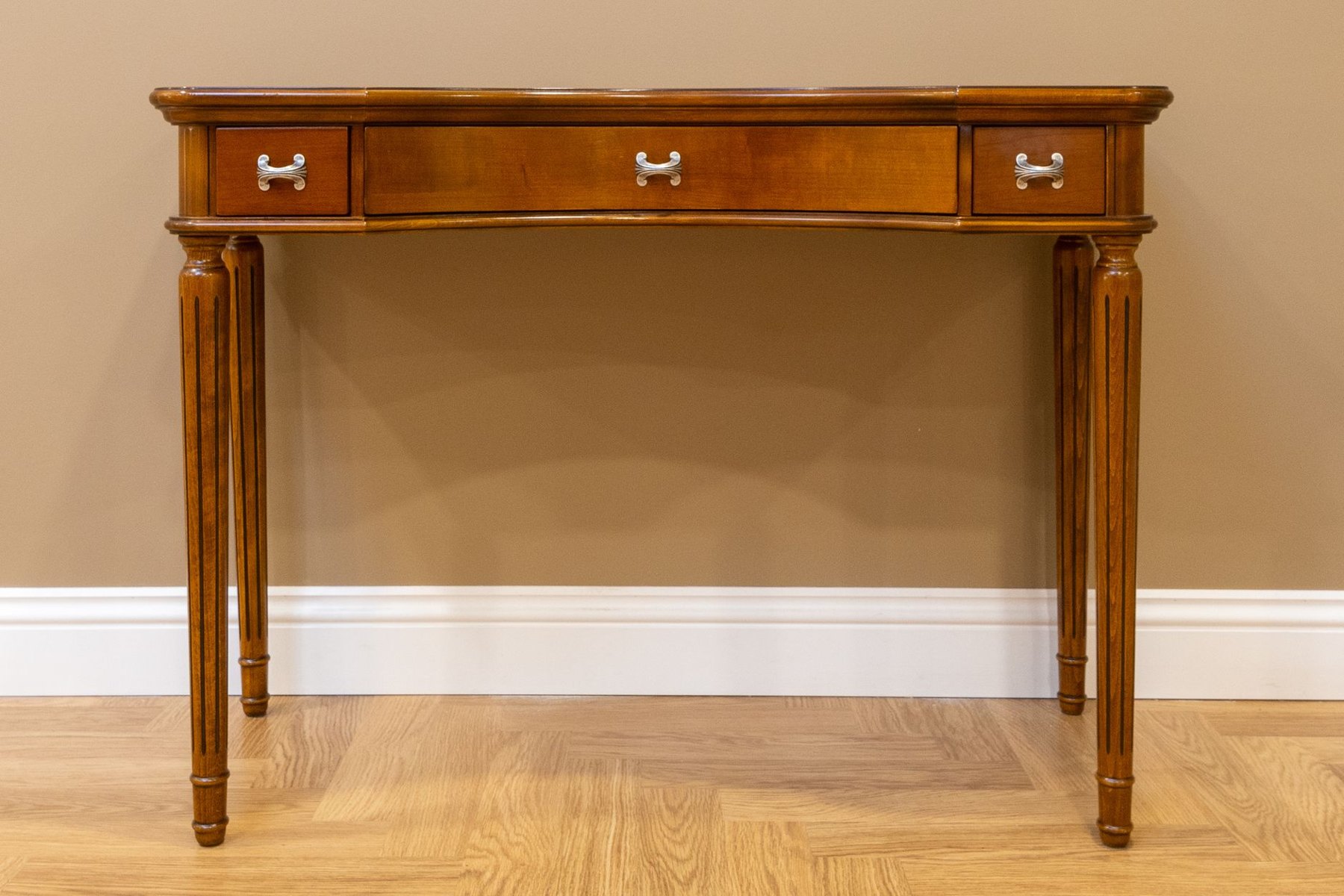
| Console with one shallow drawer | Keeping small essentials out of sight | Needs clearance to open and usable internal dimensions |
| Console with a lower shelf | Containing a few baskets beneath the top | Baskets can project into the walking route |
| Wall-mounted console | Keeping the floor below clear | Depends on suitable mounting and permission to install |
| Console with rounded front corners | A route that passes close to the table ends | Rounded ends reduce usable corner space |
Look closely at leg placement
Product photos tend to emphasize the tabletop, but the base deserves equal attention. Angled legs may extend beyond the top. Feet can sit exactly where you step when reaching for keys. A stretcher connecting the legs may prevent a basket from sliding underneath.
Look for a dimension drawing and photographs from the side. If the overall footprint is unclear, confirm it before buying. A tabletop measurement alone cannot tell you whether the base fits beside a doorway.
Check the space between the legs
If you plan to store baskets below the console, measure the clear opening between the legs and beneath any drawer apron. Overall table width does not equal storage width. A basket may fit through the front opening yet catch on a rear brace or lower crossbar.
For a shared entryway, consider how people approach the table. Legs near the front corners can interfere with feet when someone stands close. A recessed base may feel easier to approach, but it still needs a stable design and must be used according to the manufacturer’s instructions.
Make drawers earn their space
A drawer is useful when it holds specific things: spare keys, sunglasses, or a dog lead. It becomes less useful when it is too shallow for those items or requires everyone else to stop walking whenever it opens.
Check internal drawer width, depth, and height. These are different from the external drawer-front measurements. Also check the pull: a projecting handle adds to the closed footprint, while a recessed pull may be harder for some users to grip.
- For keys and small accessories: choose a drawer that can accommodate a simple organizer without wasting its limited height.
- For mail: check that your usual envelopes fit without folding or catching.
- For shared use: consider whether separate small drawers would be easier to manage than one mixed compartment.
- For a very tight passage: an open landing surface may be more practical than a drawer that blocks the route.
Ask for the open-drawer projection if it is missing from the listing. Test that distance on the floor plan before ordering.
Treat stability as a separate buying decision
A console should stand securely on your actual floor and suit the loads you intend to place on it. Do not judge stability from weight, material, or appearance alone. Review assembly instructions, load limits, and any supplied anti-tip or wall-fixing requirements.
Baseboards can prevent the back of a table from sitting close to the wall. Uneven flooring may also affect how it stands. Adjustable feet can help with leveling when provided, but they do not replace required anchoring or correct assembly.
If children or pets share the home, consider foreseeable pulling, climbing, and bumping when choosing both the table and its contents. Follow all anchoring instructions, and avoid putting tempting or heavy objects where they could be pulled down. A console should never serve as a seat unless expressly designed for that purpose.
For rentals, check installation requirements first
A freestanding appearance does not mean a table can safely be used without wall fixings. Read the instructions before purchase. If drilling is restricted, choose a design whose installation requirements you can meet. Do not substitute adhesive attachments for specified furniture anchors.
Choose useful storage and manageable finishes
A lower shelf can contain everyday clutter, but only if its storage stays within the table’s footprint. Measure basket handles and any tapering sides. Leave enough room to lift or slide each basket out without striking the tabletop above it.
Think about cleaning, too. A low shelf creates another surface to dust and may limit access underneath. An open base leaves fewer surfaces to maintain, while closed storage hides contents but adds doors, hinges, and opening clearance.
Check care instructions for the finish, especially if you routinely put down damp umbrellas or cold drinks. Use a suitable tray for wet or dirty items. If adding a lamp, confirm that its base fits fully on the tabletop and that the cable can reach an outlet without crossing the passage.
A practical shortlist before checkout
Keep a shallow open console on your shortlist if you mainly need a place to drop keys. Consider one drawer if small items regularly disappear. Choose a lower shelf only when you have measured the baskets it will hold. A wall-mounted design is worth considering when floor access matters and suitable installation is possible.
- Confirm the full depth, including handles and feet.
- Test the walking route and nearby door swings.
- Verify drawer interiors and opening clearance.
- Measure clear space between legs and shelves.
- Read assembly, anchoring, load, and care instructions.
Before ordering, leave the proposed footprint marked through a normal arrival home. Notice where you pause, turn, set down bags, and remove shoes. Those movements will tell you whether the console belongs there—and how much storage you can comfortably use.